Why Database Schema Design is the Key to Long-Term Performance
When tackling performance issues in databases, many professionals immediately look for problematic queries or inefficient indexing strategies. However, the root cause often lies deeper than bad queries: it lies in bad tables. The way tables are created sets the foundation for database performance for years to come. Every CREATE TABLE statement is a critical, long-term decision that influences how efficiently data can be accessed, stored, and maintained.
In this post, we’ll dive into why schema design is where performance truly begins and explore the critical elements you need to keep in mind when designing your tables for optimal performance.
The Importance of Thoughtful Table Design
Your database schema is more than just a structure for storing data; it’s a blueprint that affects how data is retrieved and manipulated. Poorly designed tables can cause excessive disk usage, slow query times, and complex maintenance challenges down the line.
Here are the key aspects to focus on when creating tables for long-term success:
1. Choosing the Right Data Types
Data types not only determine what kind of information can be stored but also impact storage size and calculation efficiency. Using the most suitable data types ensures efficient space usage and faster processing.
Best Practices for Data Types
- Use the smallest data type that can store your data: For example, use
INTorSMALLINTrather thanBIGINTif the range of values allows. - Be cautious with
VARCHARlengths: Overestimating size can waste space and slow indexes. - Consider fixed-length versus variable-length data types: Fixed-length can be faster for certain workloads but may waste space if not used carefully.
2. Strategic Use of Indexes
Indexes are essential for speeding up query performance but can also negatively impact write speeds and storage if used excessively or incorrectly.
How to Approach Indexing
- Index columns that are frequently used in WHERE clauses or joins.
- Use composite indexes wisely: Order columns in the index based on query patterns.
- Regularly monitor index usage and remove unused indexes.
3. Defining Constraints Carefully
Constraints, such as primary keys, foreign keys, unique constraints, and checks, play a crucial role in maintaining data integrity. Proper constraints can also optimize performance by helping the database engine understand relationships and enforce rules efficiently.
Impact of Constraints
- Primary keys: Make sure every table has a primary key defined for faster lookups.
- Foreign keys: Use them to maintain relationship integrity but be mindful of their impact on insert/update performance.
- Unique constraints: Help prevent duplicates and enable the optimizer to make smarter decisions.
4. Considering Partitioning for Large Tables
Partitioning divides a large table into smaller, more manageable pieces without changing the logical table structure. Proper partitioning can drastically improve query and maintenance performance on large datasets.
Types of Partitioning
- Range Partitioning: Data is divided based on ranges of values, such as dates or numeric ranges.
- List Partitioning: Data partitioned by a list of values, useful for categorically grouping data.
- Hash Partitioning: Distributes data evenly across partitions based on a hash function.
Choosing the right partition strategy depends on your query patterns and data distribution.
Putting It All Together: Schema Design is a Strategic Investment
Re-designing databases to fix performance problems after the fact can be costly and complex. Investing time and thought into the initial schema design pays dividends in improved query performance, scalability, and maintainability.
Remember, every decision made during the CREATE TABLE phase echoes throughout your entire application lifecycle. Optimizing your tables now will save you from headaches and bottlenecks later.
Example: Applying These Principles in a Real-World Scenario
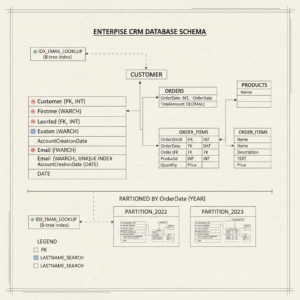
Consider an e-commerce database storing orders and customers:
- Use appropriate data types: Store order quantities as
SMALLINTif values are small. - Define a primary key on
order_id. - Create indexes on
customer_idandorder_dateif these fields are often used in queries. - Apply foreign key constraints from orders to customers to ensure referential integrity.
- Partition the orders table by
order_dateusing range partitioning for efficient access to recent orders.
Conclusion
Most performance headaches don’t stem from badly written queries alone—they often originate from foundational design decisions made in the database schema. Thoughtful attention to data types, indexes, constraints, and partitioning during the CREATE TABLE stage sets the stage for efficient, scalable, and maintainable databases.
For a deeper dive into this topic and to learn from years of experience in designing and redesigning databases, read more at this detailed article.

Invest in your schema design today and reap the benefits for years to come.