
The Real Challenge of Microservices: It’s Not the Code, It’s the Coordination
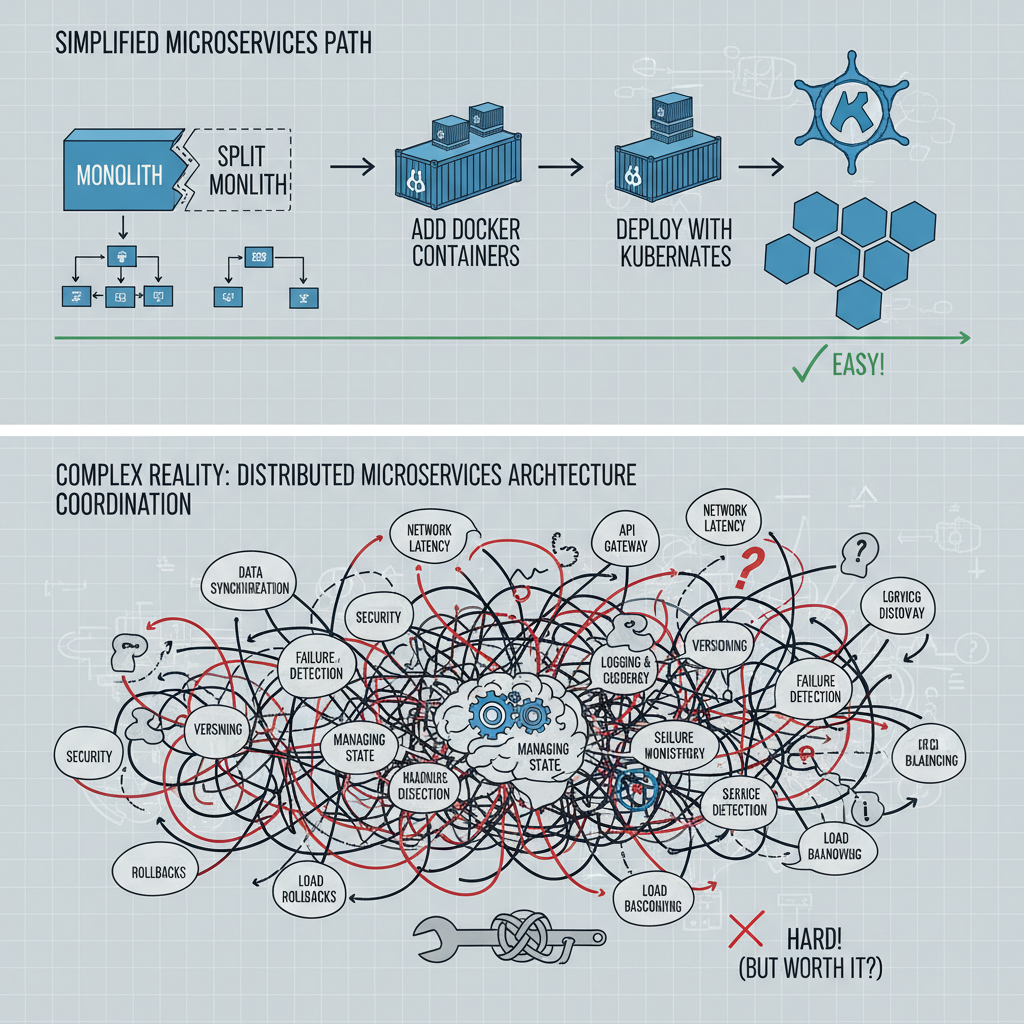
“It’s not the code that kills you. It’s the coordination.” This concise insight from @robyurself on X (formerly Twitter) brilliantly captures the essence of the microservices journey. While many development teams envision microservices as a straightforward process of splitting up monoliths and leveraging modern deployment tools, the true challenge lies far deeper—in the orchestration and management of a complex distributed system.
The Allure of the Microservices Path
When teams consider transitioning to microservices, the roadmap often looks deceptively simple:
- Split the monolith.
- Add Docker containers for packaging.
- Deploy using Kubernetes for orchestration.
This sequence appeals because it feels like a logical, incremental progression: break up the large codebase into smaller, manageable pieces, then harness containerization and orchestration technologies to streamline deployment and scalability.
Understanding the Real Work: Managing Distributed Complexity
Breaking up the monolith is just the first step. What follows is managing a nuanced and highly complex distributed system. Each microservice is an autonomous piece of the puzzle but must collaborate seamlessly at runtime. The following critical areas highlight the complexity involved:
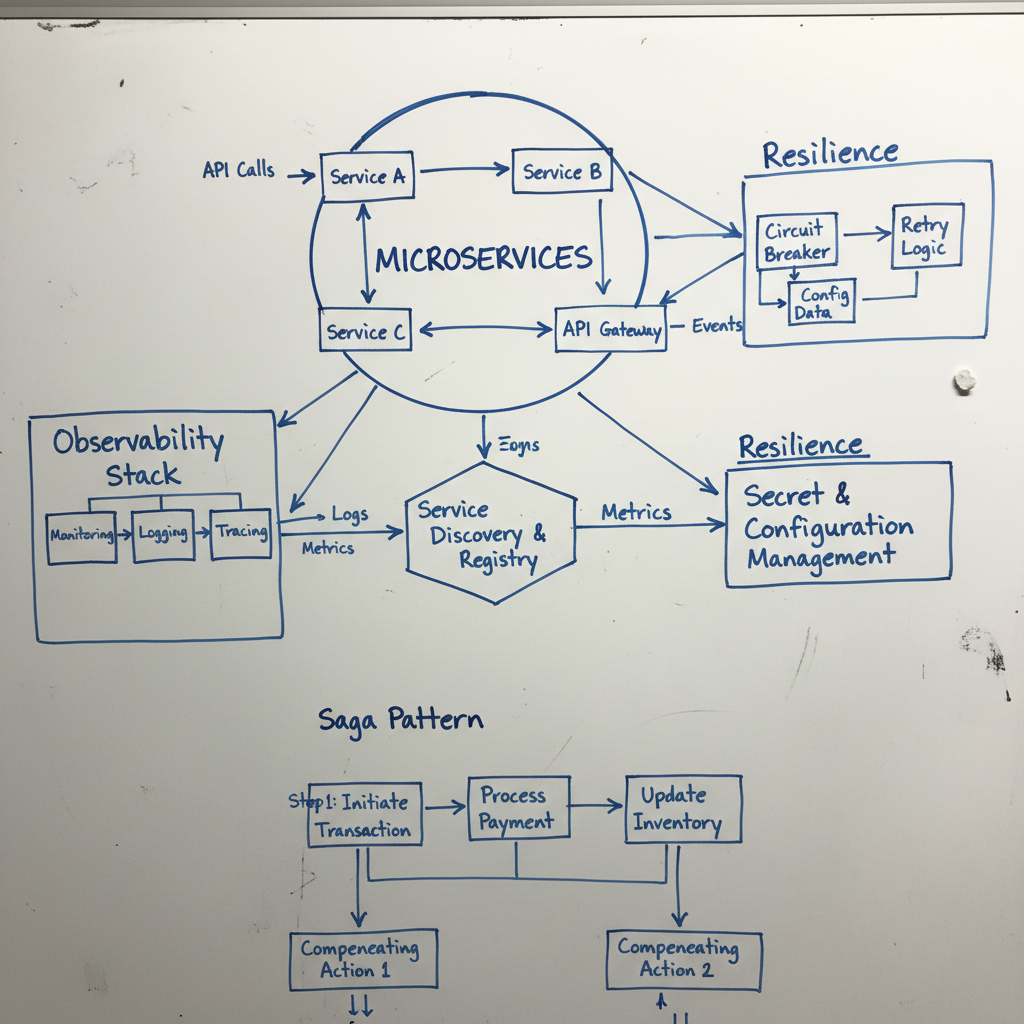
1. Observability Stack
In a distributed system, understanding what is happening inside each microservice is paramount. Observability tools—such as monitoring, logging, and tracing—combine to provide a holistic view of system health and performance. Without a robust observability stack, pinpointing issues or bottlenecks becomes nearly impossible.
Examples of observability tools include Prometheus for metrics, ELK stack for logging, and Jaeger for distributed tracing.
2. Secret & Config Management
Microservices must often access sensitive information such as API keys, database credentials, or third-party service tokens. Managing these securely and distributing configurations consistently across services is challenging, especially as services scale in number.
Tools like HashiCorp Vault or Kubernetes Secrets help ensure that secrets and configurations are centrally managed but accessed securely and updated consistently.
3. Data Consistency & Sagas
Unlike monoliths where transactions can be perfectly managed within a single database, microservices usually distribute data across different services or databases. Maintaining consistency is tricky and traditional ACID transactions are often impractical.
The Saga pattern is a popular approach for managing distributed transactions. It breaks a transaction into a series of smaller steps with compensating actions for failure handling. This approach helps maintain eventual consistency but requires careful implementation.
4. Circuit Breakers & Retry Logic
Microservices communicate over the network, introducing risks like latency, failures, or service unavailability. Circuit breakers help by detecting failures and preventing cascading errors, while retry logic attempts to recover from transient faults.
Implementing these patterns increases system resilience but involves tuning thresholds and error handling strategies based on service requirements.
5. Service Discovery & Registry
With multiple dynamic services running, their locations (IP addresses, ports) change frequently. Service discovery mechanisms enable services to find and communicate with each other without hard-coding endpoints.
Service registries such as Consul, Eureka, or Kubernetes native tools automatically track service instances and provide discovery capabilities, simplifying dynamic routing and load balancing.
Actionable Insights for Teams Considering Microservices
Understanding the complexity of coordination before diving into microservices can save teams from costly pitfalls. Here are some best practices and tips:
- Invest in observability early: Setting up proper monitoring and tracing upfront facilitates debugging and performance optimization.
- Centralize configuration management: Avoid configuration sprawl to ensure consistency and security.
- Embrace patterns like Sagas and Circuit Breakers: These are essential for maintaining robustness in distributed transactions and communication.
- Automate wherever possible: Use tools for service discovery, secret management, and retries to reduce manual errors.
- Educate teams about distributed systems complexity: Build internal knowledge to handle failures gracefully and design resilient services.
Conclusion: The Journey Beyond Code Splitting
While breaking up a monolith and adopting container orchestration technologies like Docker and Kubernetes might seem like the path to modernity, the real challenge of microservices architecture lies in the orchestration of distributed complexity. It’s an involved process that demands robust tooling, disciplined patterns, and a mindset focused on coordination rather than just code.
Teams that succeed are those that recognize this upfront and equip themselves with the right knowledge, tools, and processes to build resilient, scalable distributed systems.
What has been the one element your team found most surprising or challenging in the “actually needed” list when adopting microservices? Share your experiences and insights below!
For further reading on microservices best practices, check out the Microservices.io resource hub and dedicated Kubernetes documentation at Kubernetes Official Docs.